The straightening and cutting machine is equipment used for processing metal wires (such as steel bars, steel wires, copper wires, etc.), whose main functions are to straighten bent wires and accurately cut them to a set length. Its core working principles can be divided into two parts: the straightening principle and the cutting principle. The cutting methods of different machine models (such as flying shear type and follow-up shear type) vary slightly, as detailed below:
I. Straightening Principle
The straightening process is mainly achieved through the extrusion and correction of the straightening wheel set, with specific steps as follows:
Multi-Wheel Extrusion Correction
The wire passes through multiple straightening wheels arranged at a specific angle (usually two rows, upper and lower, staggered). The straightening wheels are made of high-strength wear-resistant materials (such as cemented carbide).
When the wire passes through the straightening wheel set, the bent wire is subjected to the extrusion and reverse bending of the straightening wheels, gradually eliminating the original curvature.
By adjusting the spacing and angle of the straightening wheels (some models support electric or manual adjustment), it can adapt to wires of different diameters and hardness (such as steel bars, stainless steel wires, etc.).
Elastic Deformation and Plastic Deformation
The wire first undergoes elastic deformation (which can return to its original shape after the external force is removed). With the continuous extrusion of the straightening wheels, it gradually produces plastic deformation (permanent deformation), eventually achieving a straight state.
Some high-end models (such as servo straightening and cutting machines) are equipped with a dynamic straightening system, which can automatically adjust the parameters of the straightening wheels according to the real-time state of the wire to improve straightening accuracy and efficiency.
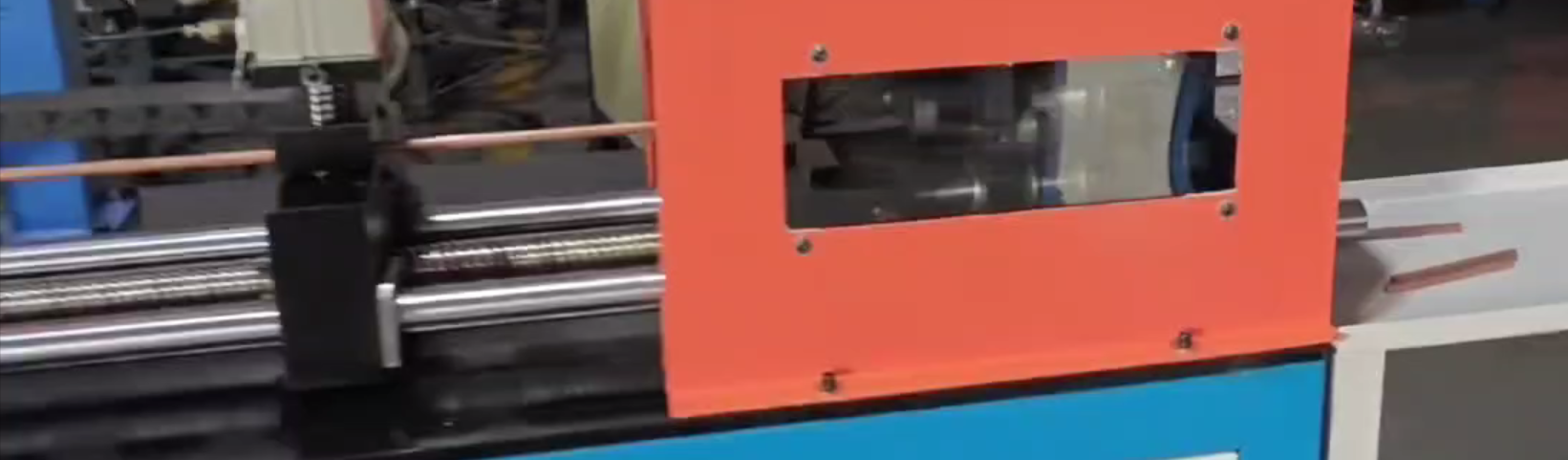
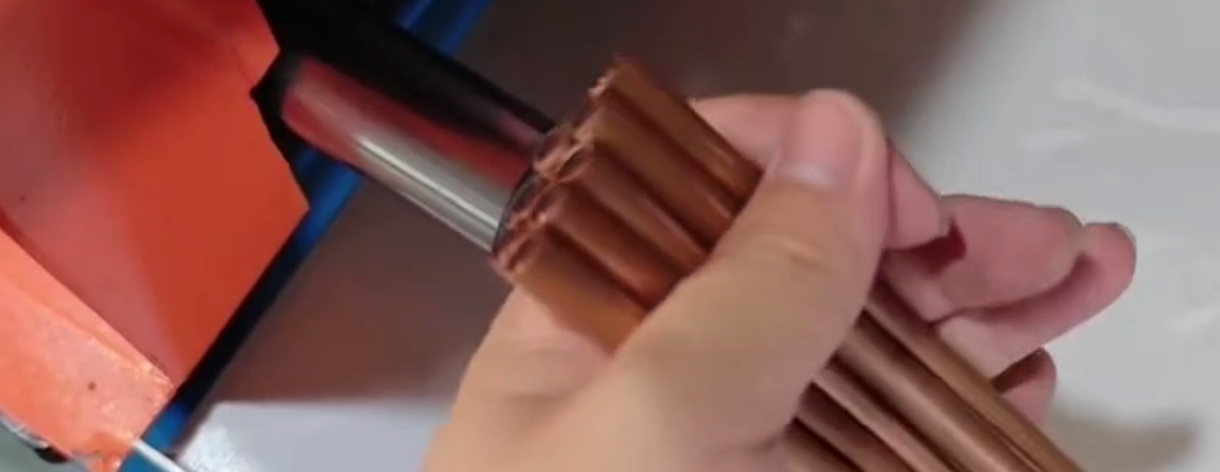
II. Cutting Principles (Differences Between Machine Types)
The cutting methods of straightening and cutting machines are mainly divided into three types: stationary shear, flying shear, and follow-up shear. The core difference lies in whether the wire stops moving during cutting:
1. Stationary Shear (Traditional Model)
Working Characteristics: Feeding must be paused before cutting, and the wire feeding resumes after cutting is completed.
Principle:
After straightening, the wire is pushed by the feeding mechanism (such as feeding wheels) to the set length.
When the wire reaches the cutting position, the feeding mechanism stops, and the cutting mechanism (such as a hydraulic shear or mechanical cutter) acts to cut the wire.
Disadvantage: Low production efficiency due to stop-and-cut operation, suitable for scenarios with low speed requirements.
2. Flying Shear (High-Speed Continuous Production)
Working Characteristics: The wire continues to move without stopping during cutting, and the shear blade moves synchronously with the wire ("cutting on the fly").
Principle:
The shear blade is installed on a high-speed rotating cutter disc or reciprocating slider. The control system calculates the wire speed and cutting length.
When the shear blade's movement speed matches the wire speed, the blade cuts into the wire to complete the cut, ensuring a flat cutting surface without stretching deformation.
Advantage: High production efficiency (up to tens of meters per minute), suitable for large-scale, high-precision cutting (e.g., steel bar processing production lines).
3. Follow-Up Shear (Servo-Driven High Precision)
Working Characteristics: The cutting mechanism actively "chases" the wire's movement to achieve synchronous cutting.
Principle:
The feeding mechanism conveys the wire at a constant speed, while the cutting mechanism (such as a servo motor-driven shear) calculates the wire's position and speed in real time through the control system.
The shear accelerates in the wire's movement direction to "chase" it. When reaching the synchronous speed and the set length, the wire is cut instantly without stopping the machine.
Advantage: Extremely high cutting precision (error can be controlled within ±1mm), suitable for scenarios with strict length accuracy requirements (e.g., electronic wires, medical device wires).
III. Core Control System
The precise operation of the straightening and cutting machine relies on the control system, whose core functions include:
Parameter Setting: Input parameters such as straightening speed, cutting length, and feeding times.
Synchronous Control: Coordinates the actions of the straightening wheels, feeding mechanism, and cutting mechanism to ensure speed matching (especially in flying shear/follow-up shear modes).
Sensor Detection: Monitors the wire's length and position in real time through encoders, proximity switches, etc., to trigger cutting signals.
Fault Alarm: Detects equipment anomalies (such as overload or tool wear) and triggers shutdown alarms to ensure production safety.
IV. Typical Application Scenarios
Construction Industry: Straightens and cuts steel bars (e.g., Φ6-Φ40mm steel bars) for concrete structure construction.
Metal Processing: Processes steel wires, copper wires, stainless steel wires, etc., for producing springs, iron nails, steel wire ropes, etc.
Electronics and Electrical Appliances: Cuts precision wires and electrode materials (such as enameled wires) with length accuracy up to ±0.5mm.
Automotive Manufacturing: Processes steel wires for seat belts, brake cables, etc., requiring both efficiency and surface quality.
Conclusion
The straightening and cutting machine corrects the wire's shape through the straightening wheel set and achieves precise length cutting through dynamic or static cutting mechanisms. Its core advantages lie in high automation, fast production efficiency, and stable cutting precision. Different machine types (stationary shear, flying shear, follow-up shear) are suitable for different scenarios, allowing users to select appropriate equipment based on wire material, production speed, and precision requirements.







 Home
Home


